Retail “AI Trading Bots”: The Engineering of Mass Delusion
The most scalable and easily marketed illusion in our industry today is the concept of the “out-of-the-box AI trader.” Unlike niche infrastructure solutions, this gimmick targets the broadest possible audience. It exploits the retail investor’s core desire: to generate passive income without ever diving into math or writing a single line of code.
The market is currently flooded with services offering to connect your exchange account via API to a “secret neural network algorithm” that can supposedly predict asset price movements. Here is a technical breakdown of how this business model actually works under the hood.
Product Architecture: Illusion over Intelligence
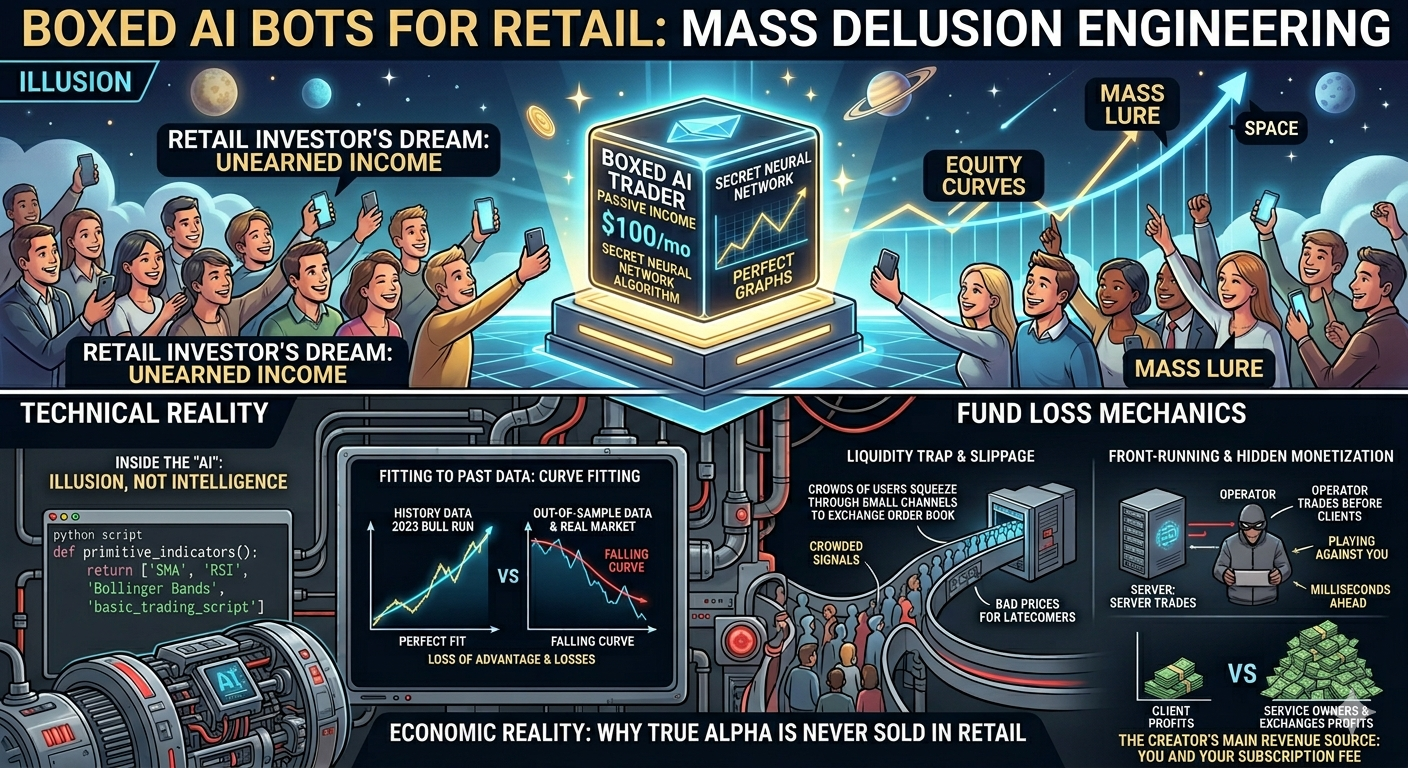
Marketers feed the public a myth about an autonomous algorithm that, for a modest $30–$100 monthly subscription, will consistently generate alpha on spot or futures markets. To prove its efficacy, clients are shown equity curves with a flawless upward trajectory. From an engineering standpoint, however, this product is nothing more than a collection of standard statistical manipulations.
In 99% of cases, the core of a mass-market retail bot is neither a large language model nor a complex neural network. It is a primitive Python script relying on moving average crossovers, RSI, or Bollinger Bands. The illusion of artificial intelligence is manufactured during the backtesting phase through a process known as curve fitting.
The Mechanics of Curve Fitting: The algorithm is run through historical data for a specific period (e.g., the 2023 bull market) using thousands of parameter variations. The creators simply cherry-pick the exact combination of settings that historically yielded the highest profit.
The Reality: The resulting model is rigidly tied to the market noise of that specific historical window. The moment the algorithm encounters the live market (out-of-sample data), it loses its statistical edge. The mathematical expectation of trades turns negative, and, factoring in trading fees, the deposit is systematically wiped out.
The Liquidity Trap and Front-Running
Even if we assume the existence of a locally effective algorithm, mass distribution immediately kills its profitability.
Strategy Scalability: Every trading strategy is constrained by liquidity depth. When thousands of retail bot users receive the exact same buy signal for an illiquid asset, massive slippage occurs. The first few orders are executed at the target price, while the rest of the herd sweeps the order book at the worst possible prices.
Hidden Monetization (Front-running): Platforms that aggregate client order flows through their servers possess insider information about the crowd’s aggregate positioning. Technically, nothing prevents the service owners from using this data to front-run their users—placing their own orders milliseconds before the clients’ or leaking information to market makers to trigger stop-loss cascades.
The Economic Reality: Why the Holy Grail Isn’t for Sale
The ultimate argument against mass-market “money-making buttons” lies in dry economic logic.
Mathematically proven alpha is a finite resource. If a quantitative engineer builds an algorithm with a stable positive expected value and manageable drawdown, they do not sell it to retail users. A working strategy is scaled via leverage or by attracting institutional capital.
If someone is selling signal subscriptions or renting out a bot to individuals, it means the creator’s true source of income is the subscription fee, not the trading results.
Conclusion
The concept of a retail AI bot is simply a wealth-transfer mechanism from unqualified users to service providers and exchanges (via fees). A truly functional algorithmic trading architecture cannot survive public exposure. It requires proprietary infrastructure, ruthless risk management, dedicated hosting to minimize latency, and total control over execution logic.
Any “out-of-the-box” solution promising to delegate these complex processes to a black box is a mathematical anomaly with a highly predictable ending.
🎓 https://nexus-bot.pro/ · 📊 https://nexus-bot.pro/proof/rvv/ $BTC $ETH #AITrading #TradingBot #CryptoScam #AlgoTrading #RiskManagement #CryptoTrading